|
|
|
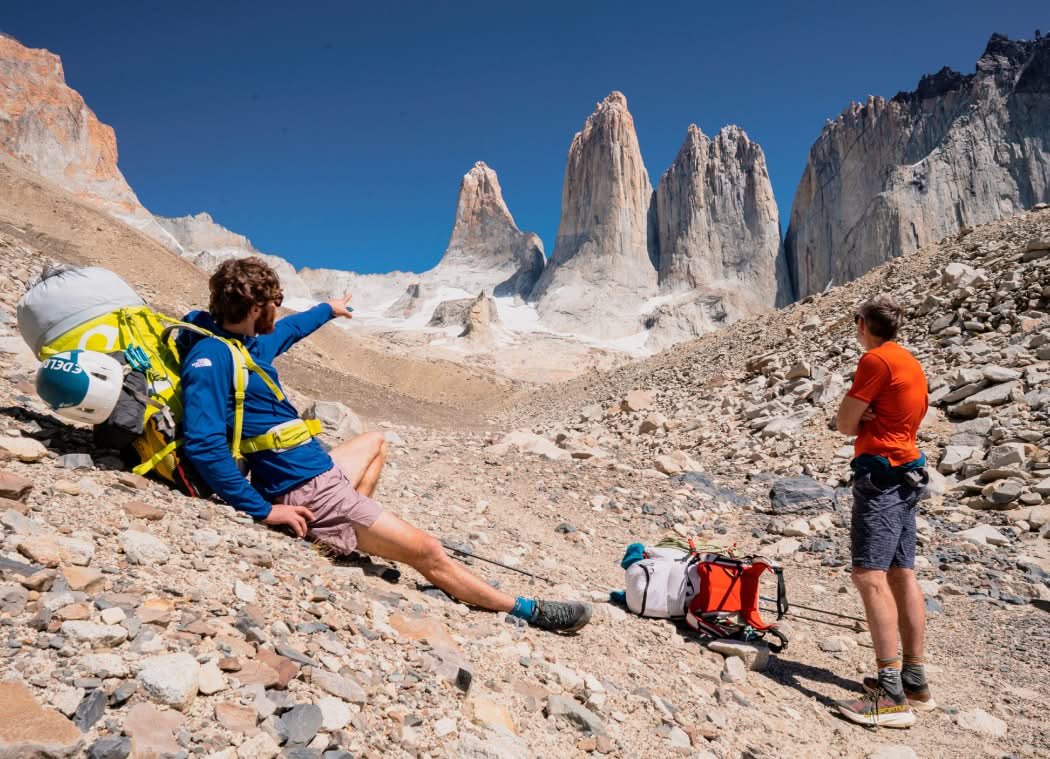
Siebe Vanhee and Tommy eyeing up the Torres on a sunny approach day. Photo: Felipe Tapia Nordenflycht
|
|
|
|
We were hoping for a solid three-day weather window. We didn’t get it, but we tried anyway.
Our first attempt on the South African Route on the Central Tower of Paine was warm. On a wall this steep and snowy, that meant the hard pitches were running with water. We bailed after 11 pitches.
On our second try, it was colder, so there was less water. But when we hit pitch 21, the temperature dropped and it started snowing. The cracks filled with verglas and we retreated again, this time getting our ropes stuck several times. It took nine hours to rappel. We crawled back to our tent at 3 a.m.
As we hiked out the next day, my climbing partner, Siebe Vanhee, told me he might not want to try again.
“You’ll change your mind when the pain fades a little,” I told him.
In truth, I had been doubting how worth it this climb was myself. A decade ago, when I started a family, I had told myself my days of climbing in Patagonia were probably over. It had been a heartbreaking decision, as some of the best climbing days of my life had been there.
I was 22 on my first trip when Topher Donahue and I climbed the first free ascent of the East Face of Fitz Roy, a mind-bending 50-hour continuous push up a 4,000-foot route with 5.12+ free climbing and hard mixed pitches. We figured we’d bail after a few hours and hadn’t even brought bivy gear. But the climbing went fast, and we got through the hardest sections before dark. When night came, we realized climbing kept us warmer than rappelling would, so we kept going. When it got light again, we were high on the upper slopes of the mountain. Afterward, people called it paradigm-shifting. For us, it felt almost accidental.
Years later, Alex Honnold and I climbed the Fitz Traverse and spent five days skipping across clouds and summits. We were fueled by good humor and the knowledge that our time in Yosemite had trained us to move quickly across vast granite terrain. After that climb, I thought maybe I had found my place in climbing. Other disciplines had always required so much deliberate training and suffering. In Patagonia, success still demanded commitment and pain, but compared to my peers, it seemed to come naturally to me. I felt an affinity for it.
Then, Chad Kellogg died in an accident that could have happened to any of us. And he wasn’t the only one. I began to notice that accidents seemed to happen when warm weather arrived. These mountains that had been frozen together for millennia were now melting out and becoming more dangerous. I watched from afar as climbing in Patagonia only grew more popular over the past decade, and wondered if I was being overly cautious.
|
|
|
|
|
|
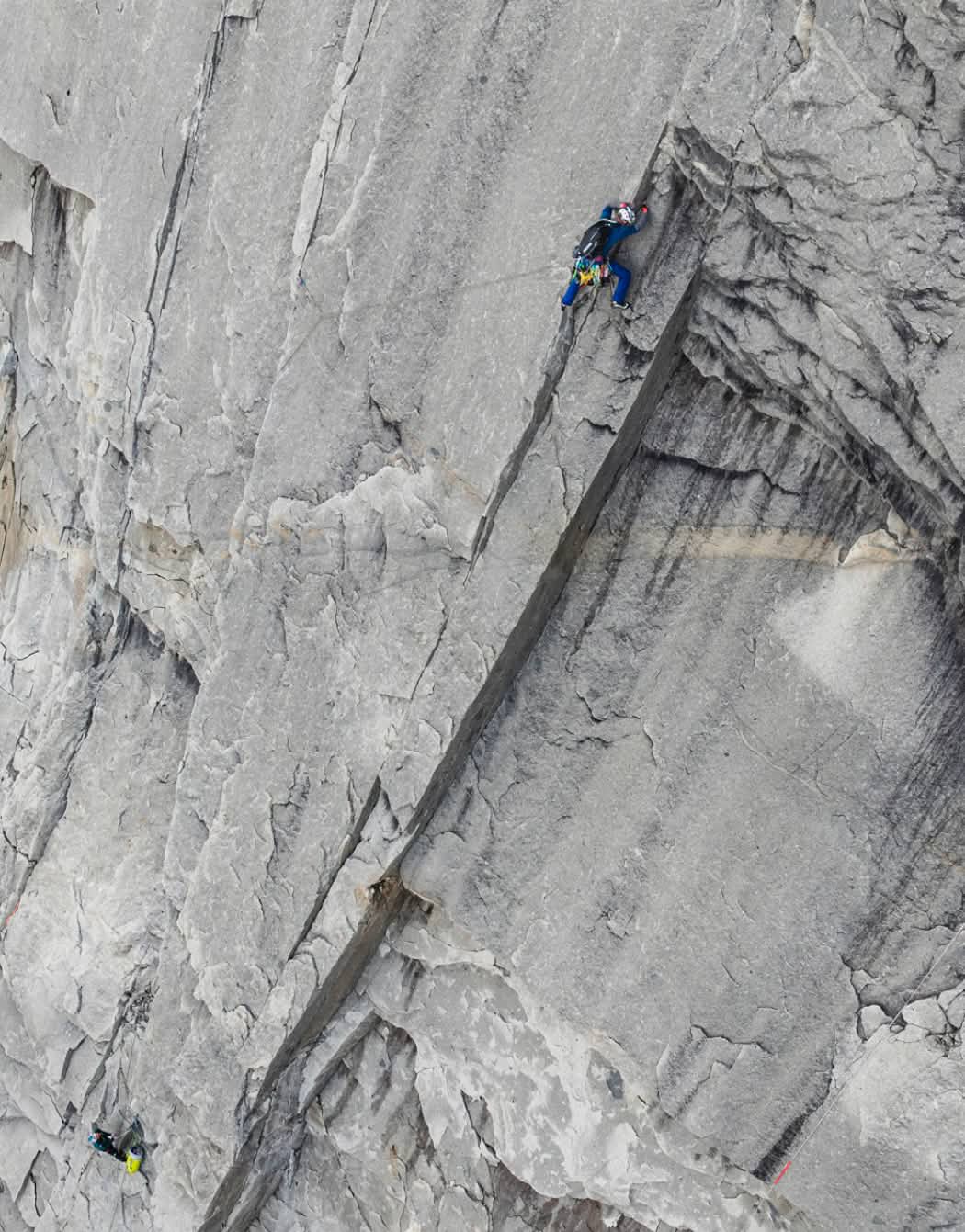
Tommy leading an airy traverse high on the South African Route. Photo: Felipe Tapia Nordenflycht
|
|
|
|
When Siebe proposed climbing the South African Route on the Central Tower of Paine in a day, I instinctively said yes. The Torres are some of the most aesthetic rock features anywhere. And I had begun rationalizing away the risks.
Unlike the peaks above El Chaltén, there’s little visible snow on the Paine Towers. I convinced myself the rock would be comparatively dry and solid. The topo seemed reasonable: 28 pitches. Mostly 5.10 and 5.11 down low. Mid-5.12 cruxes. Fourth class to the summit.
“This looks like something I could climb with Honnold in half a day,” I told myself.
I had underestimated almost everything.
The wall is bigger and steeper than it looks. Many pitches are full 60-meter rope-stretchers. The rock is worse. The easier pitches down low are filled with teetering blocks and detached flakes. Every hold and gear placement has to be tested delicately. The rock improves in the middle, but that’s also where the climbing turns hard, wide, wet and slow. One offwidth pitch took me two full hours to lead. I’ve climbed all of El Capitan faster than that.
A few pitches higher, verglas formed inside the cracks. Every cam placement had to be scrutinized to make sure the lobes weren’t biting into ice. My fingers got so cold that the tips tingled for weeks.
“It’s no El Cap,” Siebe said.
On top of that, the weather windows were shorter than I had expected. Previous parties could retreat to portaledges when storms hit. Climbing it in a day meant total commitment. After our second attempt, we festered in town for 10 days. Then another short window appeared, and you never squander a good weather window in Patagonia. We hiked back in. A week of storms had dropped heavy snow. I assumed it would just be a gear-retrieval mission.
When we got our first view of the wall, climbing it seemed pointless. Snow plastered the ledges. Water streaked down the lower slabs.
Siebe, on the other hand, seemed optimistic.
“It’s not as bad as I thought,” he said.
For our third attempt, we decided to start at 3 a.m. The first pitches were slow. Water, sometimes frozen into invisible verglas, coated nearly every hold. Each movement required sliding a hand or foot across the rock to check for slickness. But as we gained height and the wall steepened, things dried out. The sun rose, and suddenly the rock felt climbable.
We reached the crux in the warmest part of the day. For the first time, it occurred to me we might actually pull this off. With that thought came a wave of nerves—and I slipped.
I lowered, pulled the rope and sent it on the second try. Siebe took the next crux and a few more above it. Soon, we were back at the infamous offwidth. I was supposed to lead it, but Siebe said, “I need to redeem myself.”
|
|
|
|
|
|
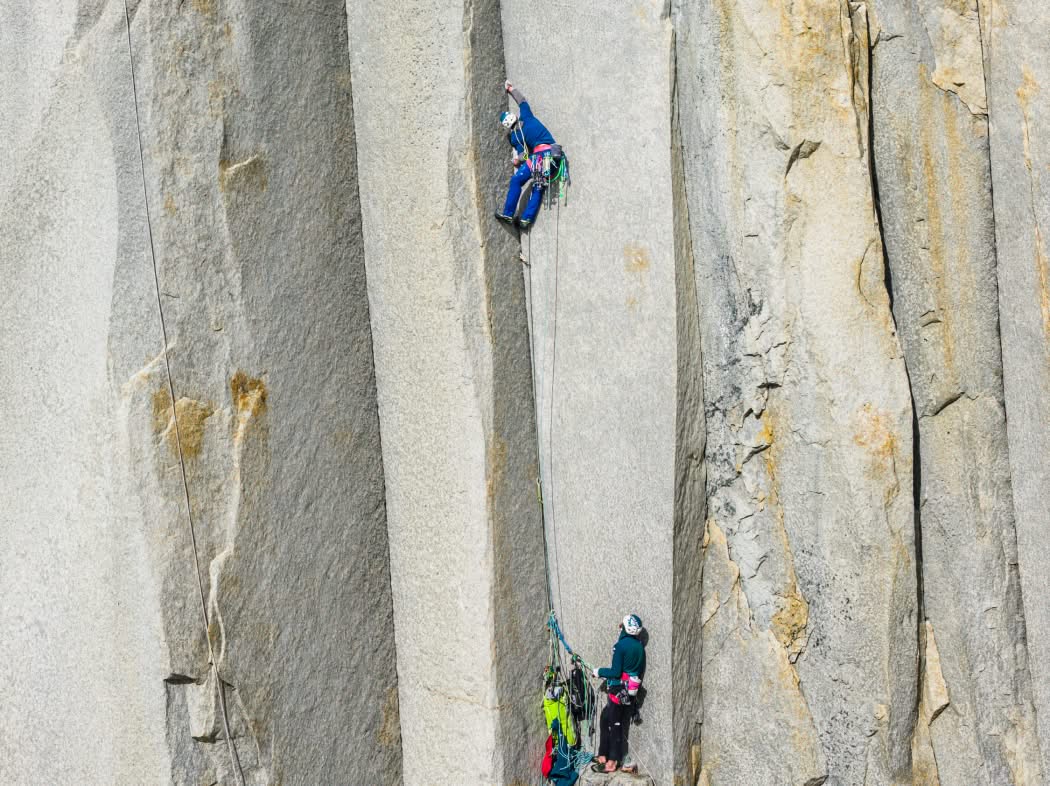
A pitch that’s as good as it gets. Photo: Felipe Tapia Nordenflycht
|
|
|
|
He led it in half the time of our previous attempt. With the rope fixed, I decided to conserve energy and layback the entire pitch. It worked, and I climbed it in 20 minutes. Suddenly, we were ahead of schedule.
Siebe was on fire, and I drafted in his wake. The pitches flew by. On pitch 20, an overhanging 5.12 finger crack, I watched in awe as he committed above his gear, risking a massive ledge fall. He didn’t even seem rattled.
We reached the end of the fifth-class terrain just after dark. We fired up the stove, melted snow, drank electrolytes and coffee, and switched into mountain boots. I took the lead. For the next several hours, we plowed through snow-covered ledges, navigating tricky terrain toward the summit. Route-finding slowed us, but at 3 a.m., 24 hours after starting, we stood on the top. As we tagged the summit, the wind picked up and it began to snow.
During the rappels, visibility shrank to just a few feet. We dug for anchors and triple-checked that we weren’t dropping off the wrong side of the mountain. As dawn approached, the snowfall intensified. Spindrift avalanches poured over us, making it impossible to look up at times. Pulling ropes kept us just warm enough to stave off hypothermia.
I told Siebe the other day that I feel full to the brim. We had climbed a wall that usually takes weeks in a single push. While I am proud of what we accomplished, trying to make sense of the experience leaves me unsettled. Why do I feel compelled to expose myself to such risk? There’s something addictive about feeling capable in a situation almost no one else can handle. This kind of climbing feels like something I’m personally encoded to do.
And the intensity creates presence. It reveals beauty. Snow crystals landing on my glove, then blowing away in the Patagonian wind. The glimmer of my headlamp reflecting deep blue light from ice hidden inside cracks. Orange and red sunsets as the shadows of tooth-shaped mountains stretch across the plains until the horizon swallows the light and an eerie cold settles in.
|
|
|
|
|
|
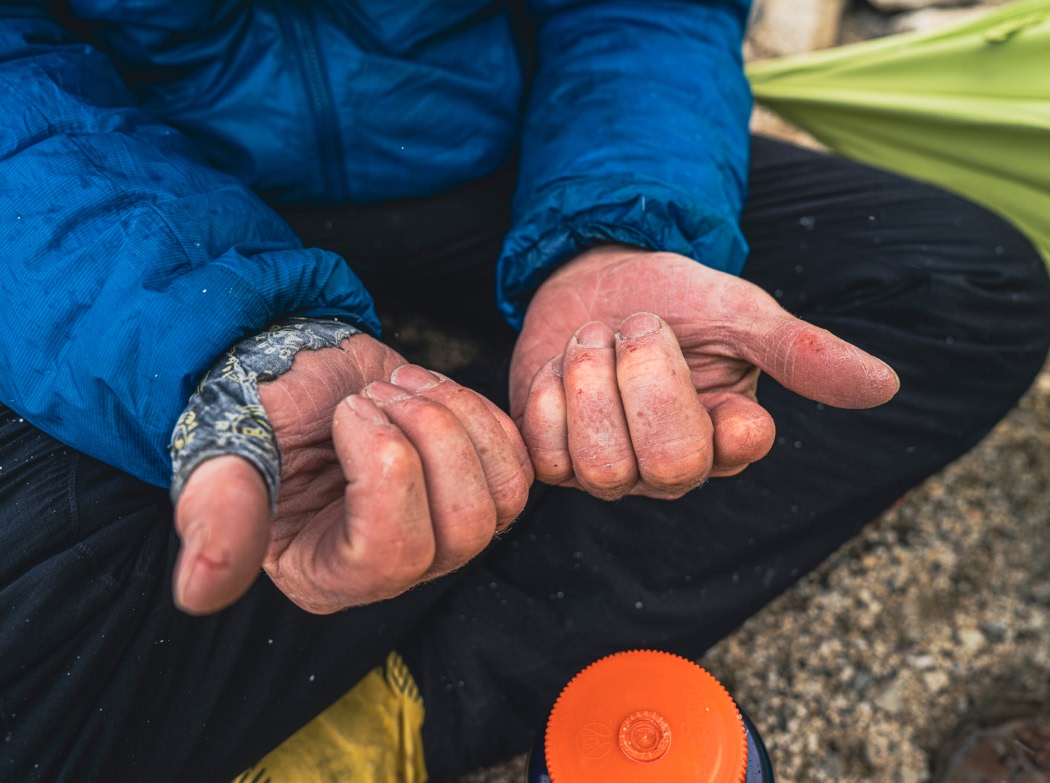
Worth the split tips and gobies? Definitely. Worth the risk? Hard to say. Photo: Felipe Tapia Nordenflycht
|
|
|
|
|
Rationally, I’m not sure this is worth it. But the truth is, I don’t want to give these experiences up entirely. We can never really justify this kind of climbing and the risk we expose ourselves to. Having a family is what helps me draw the line more conservatively and will hopefully keep me alive. As long as we go into mountains like these, this tension is going to exist. Maybe finding peace in that is the best we can do.
|
|
|